


- Home
- Specialties
- Eye Surgery in Panama
Eye Surgery in Panama
Eye Surgery Institute

At The Panama Clinic, through its Eye Surgery Institute, a comprehensive ophthalmology service is offered for the diagnosis, treatment and monitoring of visual disorders, with cutting-edge technology and hospital support in the same place.
Office Hours
Monday to Saturday
8:00 am to 5:00 pm
Agreements with Major Insurers


We accept national and international insurance to give you access to quality services.
When should I consult for eye surgery?
Not all visual discomfort requires surgery, but an evaluation with an ophthalmologist helps identify the cause and define the appropriate treatment. In the consultation, your medical history, your symptoms, current medication are reviewed and a complete eye exam is performed to determine if there is a surgical indication or if another management is appropriate.
- Cloudy or foggy vision that progresses over time, common in cataracts.
- Glare or halos with lights, especially when driving at night.
- Decreased vision that does not improve with glasses or changes quickly.
- Eye pain, redness, or photophobia, symptoms that may require priority attention.
- High intraocular pressure or suspicion of glaucoma in previous check-ups.
- Family history of glaucoma, keratoconus, or other eye diseases.
- Interest in refractive surgery to reduce dependence on glasses or contact lenses, if you are a candidate.
If you already have previous studies, lens formula or previous diagnoses, bringing them to your appointment can facilitate evaluation and more accurate decision-making.
Ophthalmology Evaluation Before a Procedure
Safety in eye surgery begins with a complete assessment. At The Panama Clinic, the process focuses on confirming the diagnosis, measuring the functional impact of the visual problem, and setting realistic expectations before defining a technique or procedure.
What does the valuation typically include?
- Visual acuity and refraction.
- Examination of the cornea, lens, and anterior segment with a slit lamp.
- Intraocular pressure measurement.
- Retinal and optic nerve evaluation, according to clinical indication.
- Complementary studies to plan surgery, laser treatment or specialized follow-up.
How do you decide if surgery is the best option?
The ophthalmologist assesses the cause of the problem, the degree of affectation in your daily life, your general health, relevant medical history and the anatomical characteristics of the eye. With this information, it is determined whether observation, medical treatment, laser or surgery is appropriate.
Why have your evaluation done at The Panama Clinic?
Choosing where to see you is an important part of the process. At The Panama Clinic you will find a comprehensive hospital in Panama City, with person-centered care, modern infrastructure and a multidisciplinary team oriented to the diagnosis, treatment and monitoring of different health conditions.
- Hospital with complete services for consultation, diagnosis, surgery and follow-up.
- Technological innovation applied to the ophthalmological area and the hospital environment.
- International accreditations and certifications granted by TEMOS and Planetree.
- Network of affiliated professionals with more than 610 doctors in different specialties.
Common eye surgery procedures
At The Panama Clinic Eye Surgery Institute , different eye pathologies are treated with a comprehensive approach. Here are some of the most relevant procedures and areas of care for those looking for information about “eye surgery in Panama.”
Cataract surgery
Cataracts occur when the lens loses transparency and affects visual quality. When they begin to limit reading, driving, or daily activities, cataract surgery may be indicated. One of the most widely used procedures is phacoemulsification, a modern technique that allows the opaque lens to be fragmented and removed and then an intraocular lens implanted.
The choice of lens and procedure planning depend on the measurements of the eye, the patient’s lifestyle, and associated conditions such as astigmatism or other eye diseases.
- What to expect: Usually outpatient procedure, with progressive visual recovery.
- What is defined in consultation: type of lens, surgical indication and aftercare according to each case.
If you’ve been diagnosed with cataracts or notice that your vision is already interfering with your daily activities, an ophthalmological evaluation can confirm the diagnosis and review treatment options.

Glaucoma and intraocular pressure control
Glaucoma is a disease that can progress without obvious symptoms in its initial stages and compromise the optic nerve. Therefore, periodic control of intraocular pressure and specialized evaluation are key, especially if there is a family history or high eye pressure in previous check-ups.
Depending on the type of glaucoma and the patient’s progress, treatment may include medications, lasers, or surgical procedures. The goal is always to protect vision and reduce the risk of progression.
- Possible options: medical management, laser procedures and surgery according to ophthalmological indication.
- Specific procedures: in selected cases, cyclophotocoagulation, an alternative to help lower intraocular pressure, may be indicated.
If you already use drops, have reported high blood pressure or suspected optic nerve damage, a glaucoma evaluation is advisable to review management options.
Cornea and refractive surgery
The cornea plays an essential role in the focus of vision. Some corneal abnormalities can cause uneven vision or limit visual quality, and should also be carefully studied before refractive surgery is indicated.
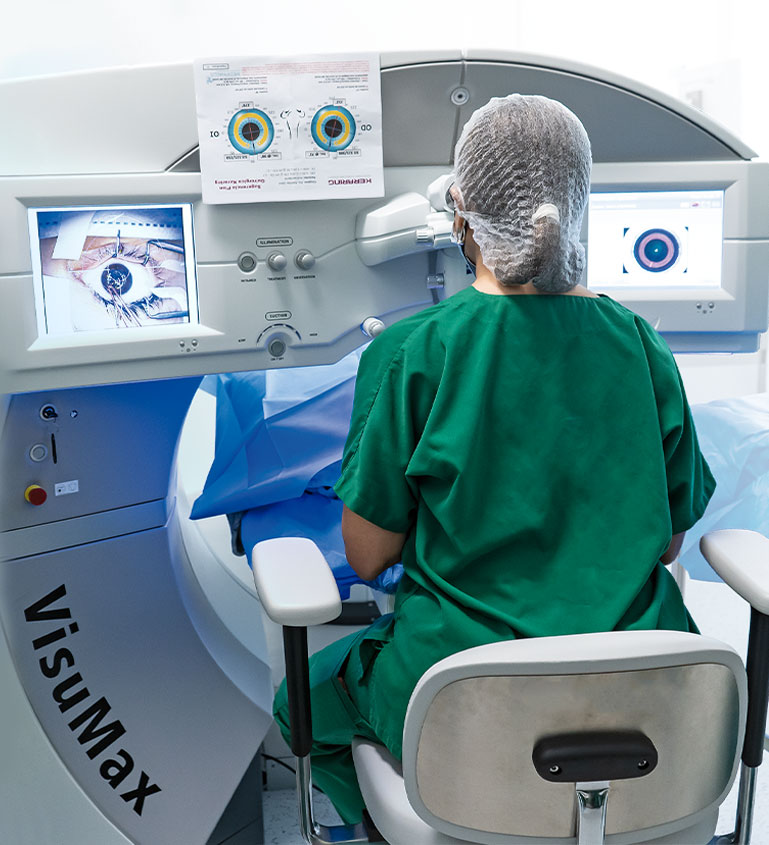
In selected patients, The Panama Clinic performs procedures such as Visumax and Femtolasik, refractive surgery techniques aimed at correcting myopia, astigmatism and hyperopia, in addition to procedures such as Corneal Cross-Linking for cases of progressive keratoconus. The decision depends not only on the graduation, but also on the thickness, shape, and stability of the cornea.
- Not everyone is a candidate: certain corneal irregularities, significant dry eye or unstable changes in prescription can modify the indication.
- Realistic objective: to improve visual quality and reduce dependence on lenses, with an individualized evaluation.
Other indications for eye surgery
In addition to cataracts, glaucoma and refractive surgery, the Institute of Eye Surgery treats retinal and vitreous pathologies, procedures such as vitrectomy and oculoplasty treatments such as pterygium or chalazion surgery. The best way to define the right path is to start with an ophthalmology assessment to identify the origin of the problem and refer to the corresponding subspecialist if required.
Technology and safety in a hospital environment
In eye surgery, good planning is just as important as the procedure itself. The Panama Clinic integrates specialized evaluation, diagnostic support and support from a comprehensive hospital, which allows care to be coordinated in a single place with a focus on safety and clinical follow-up.
- More complete diagnosis: visual examination area and state-of-the-art technology for diagnosis and treatment.
- Safety protocols: patient preparation and care in a hospital-supported environment.
- Resolution capacity: availability of state-of-the-art operating theatres, as well as hospitalisation and intensive care if necessary.
What is the process like from the first consultation to the follow-up?
An eye surgery page in Panama should explain not only the procedure, but also the complete patient journey. Here are common steps that can vary depending on the diagnosis:
- First assessment with an ophthalmologist and complete eye examination.
- Preoperative studies depending on the case, for example for refractive surgery, cataracts, cornea or retina.
- Treatment plan with explanation of options, indications, care and estimated times.
- Procedure scheduling and preoperative preparation according to each patient.
- Follow-up to monitor progress, resolve doubts and adjust treatment if necessary.
If you want to confirm times, steps and possible studies for your case, you can contact the team and coordinate an ophthalmological evaluation.
Investment and economic aspects
The cost of eye surgery depends on the diagnosis, the technique indicated, the type of procedure, the need for preoperative studies and subsequent follow-up. In some cases, it also influences whether laser, intraocular lens implantation or subspecialty management is required.
The most responsible way to guide your budget is to first assess your case and define a plan. This can provide clearer information about what the assessment includes and the next steps.
Request personalized information and they will tell you how to move forward with the assessment and quote according to your diagnosis.

Our Facilities
Responsible for the care of ocular pathologies, we offer you modern and welcoming facilities with the following general characteristics:
- Private reception
- Waiting Room
- Eye Exam Area
- State-of-the-art technology with the highest quality standards in diagnostic and treatment equipment
- Patient Preparation
- 4 operating theatres equipped with state-of-the-art technology
- Patient changing room area
- Availability of hospitalization and intensive care if needed
Specialties
Responsible for the care of ocular pathologies, we offer you modern and welcoming facilities with the following general characteristics:
Refractive surgery
Refractive Surgery is the set of surgical techniques that aim to eliminate or minimize ocular refractive errors.
These refractive problems are myopia, astigmatism and hyperopia, which can be corrected by laser techniques or through other types of treatments such as the implantation of an intraocular lens.
Procedures:
– Visumax
The Visumax laser performs the operation of myopia and astigmatism without cuts and in a minimally invasive way, using high-precision femtosecond technology throughout the surgical process, minimizing postoperative discomfort and maximizing the safety of the operation.
The procedure is quick and painless, guaranteeing the recovery of vision the day after the intervention.
“Change the way you see the world, a new life in HD awaits you”
– Femtolasik
Femtolasik is a type of laser eye surgery, more specifically the LASIK refractive surgery treatment assisted by Femtosecond laser for cutting the corneal flap.
LASIK is a technique used for the treatment of myopia, hyperopia and/or astigmatism, in which a corneal flap must be cut so that the laser can act to eliminate the diopters that the patient had.
Retina and Vitreous
The retina is essential for vision and diseases that affect it can cause permanent blindness.
People with high blood pressure or other diseases that affect the arteries are more likely to develop retinal vascular disease, which includes different disorders that affect the blood vessels or arteries inside the eye.
When cells inside the retina (the light-sensitive tissue at the back of the eye) begin to die, the process is known as retinal degeneration, which includes retinitis pigmentosa and age-related macular degeneration.
Procedures:
Vitrectomy
Vitrectomy is a surgery that must be performed mainly to remove the vitreous humor since it prevents correct vision due to various pathologies such as:
- Diabetic retinopathy.
- Retinal detachment.
- Diseases of the macula.
- Visual diseases associated with high myopia.
- Inflammation of the eye.
- In some cases of uveitis to treat diseases derived from this ocular pathology.
This surgery, which is performed under outpatient anesthesia, is performed with very thin instruments. The next day, the patient will be able to remove the occlusive patch, and during the postoperative period, the ophthalmologist will need several follow-up consultations for at least a month.
Cataracts
Cataracts darken the eye’s natural lens and limit your ability to see details. The lens, a light-sensitive membrane of the eye, functions like a camera lens. These can cause blurred vision, dull vision, sensitivity to light and glare, and/or ghosting.
Procedures:
Phacoemulsification
Phacoemulsification is a modern surgical technique widely used for cataract surgery in which the inner lens of the eye is emulsified with an ultrasonic hand tool and aspirated from the eye. In this procedure, a small corneal incision is made to access the lens through the anterior chamber of the eye (space between the cornea and iris). Then, the partition and aspiration of the cataract is performed through ultrasound using an instrument known as a phacoemulsifier.
Glaucoma
Glaucoma is one of the leading causes of blindness worldwide, it occurs when the normal pressure inside the eyes increases because the fluid in the aqueous humor, which usually flows in and out of the eye, cannot drain. Called the “stealth thief” of sight, they do not present symptoms until the optic nerve is already severely damaged, but if diagnosed early, the disease can be controlled and permanent vision loss can be prevented.
Procedures:
Cyclophotocoagulation
Micropulsed transscleral diode laser cyclophotocoagulation is a new option for the treatment of glaucoma. This procedure reduces intraocular pressure through a double mechanism, since on the one hand it decreases the production of aqueous humor in the ciliary processes and on the other it produces an increase in uveoscleral flow. The main advantages it has over conventional glaucoma surgery are the quick recovery with much lower risk of complications.
Cornea
The cornea is a structure of the eye that allows light to pass from the outside to the inside of the eye and protects the iris and lens, as well as other eye structures.
It has optical refractive properties and to guarantee its function it must be transparent and it is necessary to maintain an adequate curvature
Some of the diseases that can alter their characteristics and cause defective vision are:
- Corneal surface problems: allergies, ulcers, corneal erosions, keratitis.
- Alterations of the corneal structure, such as keratoconus.
- Infectious pathologies caused by fungi, viruses or bacteria.
- Corneal dystrophies.
- Corneal opacity.
Procedures:
Cross-Linking Corneal
Cross-linking surgery is a laser intervention specially designed to combat progressive keratoconus.
This consists of applying ultraviolet radiation to the cornea, with the aim of strengthening it and slowing down its deformation. The intervention lasts approximately 30 minutes and is performed on an outpatient basis.
Oculoplasty
Oculoplasty is the part of ophthalmology that deals with the periocular facial structures (eyelids, orbit, and tear duct) and includes a wide variety of surgical procedures that treat conditions of these structures, such as eyelid malpositions, loss of elasticity of the skin surrounding the eyes, among others.
Procedures:
Pterygium
Pterygium is a degeneration of the conjunctiva of inflammatory origin that can lead to irritation, dryness, redness, astigmatism and loss of vision if not treated in time. This surgery consists of removing the pterygium and replacing it with a graft from the patient’s own conjunctiva, causing less risk of recurrence. It is performed on an outpatient basis, with topical local anesthesia and normally, with rapid recovery.
Chalazion
Chalazion is a lump or cyst that forms on the upper or lower eyelid, as a result of an accumulation of fat secretion in the sebaceous glands deep within the eyelid. The surgery involves making a small incision on the inside of the affected eyelid to remove the contents of the affected gland without leaving any visible marks. This procedure is brief and not very aggressive, it is performed under local anesthesia and should not be recovered. Recovery takes 1 to 4 weeks for bruising to completely disappear and swelling can last up to 7 days, on average.
Frequently asked questions about eye surgery
Do I need to see an eye doctor first before having surgery?
Yes. The decision to operate requires an accurate diagnosis and a complete evaluation. The ophthalmologist determines if the origin of the problem is a cataract, glaucoma, cornea, retina or other eye condition before ordering surgery.
Is cataract surgery always done with laser?
Not always. One of the most common techniques is phacoemulsification. The choice of procedure depends on the clinical evaluation and the characteristics of each patient’s eye.
How long does recovery take?
It depends on the procedure. In many cases of cataract surgery or refractive surgery, the initial recovery is rapid, although the complete course and controls depend on the type of treatment and the individual response.
How do I know if I'm a candidate for LASIK?
It can only be confirmed by an evaluation of cornea, prescription, visual stability, and overall eye health. If LASIK is not the best option, the specialist can guide other alternatives.
What if I have high intraocular pressure after surgery?
Intraocular pressure is monitored during follow-up. If it is elevated, the medical team will indicate appropriate management based on the cause, which may include medication, close observation or other measures.